Dragon Quest IV: Chapters of the Chosen
| Main series games | |
|---|---|
| Chapters of the Chosen | |
 
| |
| Developer(s) | Chunsoft Heartbeat, ArtePiazza (PS1) ArtePiazza, Cattle Call(DS) |
| Publisher(s) | Enix Square Enix (DS) |
| Designer(s) | Yuji Horii |
| Artist(s) | Akira Toriyama |
| Composer(s) | Kōichi Sugiyama |
| Series | Dragon Quest |
| Platform(s) | Nintendo Entertainment System, Famicom, Sony PlayStation, Nintendo DS, Cell phone |
| Release date(s) | Famicom/NES JP February 11, 1990 NA October 1992 PlayStation JP November 22, 2001 Nintendo DS JP November 22, 2007 NA September 16, 2008 EU September 12, 2008 AUS September 11, 2008 Android & iOS JP April 17, 2014 NA August 7, 2014 |
| Genre(s) | Console role-playing game |
| Mode(s) | Single-player |
| Rating(s) | CERO: A (PS1, DS) ESRB: E10+ (DS) OFLC: PG |
| Media | 4-megabit NES cartridge CD (PS1) Nintendo DS Game Card |
Dragon Quest IV (ドラゴンクエストIV 導かれし者たち Doragon Kuesuto Fō Michibikareshi Monotachi, literally meaning; The People Who Are Shown the Way) is a role-playing game and the fourth installment of the Dragon Quest video game series. The game was originally released for the NES, but has been remade several times for different systems. It begins the Tenkuu (Celestial) trilogy, known better as the Zenithia trilogy in English.
It was originally released for the Famicom on February 11, 1990 in Japan. The North American version, titled Dragon Warrior IV, was released for the NES in October 1992.
Setting
Dragon Quest IV is the first of the series to not be related to the lineage of Erdrick--the game is the first of a new trilogy revolving around the legend of a castle in the sky that watches over the world below. The world map is of a comparable size to that of III, but has no direct parallels to the real world in regards to the shape of the continents and nature of the kingdoms.
Plot
The story in IV is a more character-focused tale centered around the lives of the chosen ones prior to and during their quest to prevent the resurrection of the ruler of evil, Estark. The first four chapters of the story are about the hero's companions and their own challenges and hardships. While they each travel with their own goals and dreams in mind, they all eventually discover the conspiracy of Psaro the Manslayer to drive the human race to extinction via Estark's hellish power.
Prologue

Introduces The Hero and his/her friend Eliza. This portion of the story was introduced in the PlayStation version, and became standard in later remakes.
Chapter 1: Ragnar McRyan and the Case of the Missing Children
Ragnar McRyan, one of the soldiers in the royal palace of Burland, is sent by the king on a journey to find out why children are disappearing across the kingdom.
Chapter 2: Alena and the Journey to the Tourney
Alena, princess (Tsarevna in the Nintendo DS localization) of Zamoksva, who slips out of the castle in hopes of seeing the world that exists beyond the castle walls. She is accompanied by the priest Kiryl and the mage Borya.
Chapter 3: Torneko and the Extravagant Excavation
Torneko Taloon lives in Lakanaba with his wife and son, and works part-time in the local weapon shop. He aims to become the best merchant in the world, and begins his chapter in search of a regional treasure that could help him accomplish his goal.
Chapter 4: Meena and Maya and the Mahabala Mystery
Maya Mahabala the dancer and her younger sister Meena Mahabala, the fortune teller, have left Laissez Fayre in search of vengeance against Balzack, their father's traitorous apprentice.
Chapter 5: The Chosen
The Hero has been brought up by the inhabitants of a remote and nameless mountain village. But Psaro and his legions destroy the village, leaving only the hidden hero alive. The hero leaves in search of his seven companions, in the hopes of defeating Psaro and saving the world.
Chapter 6
Chapter 6 is a post-epilogue continuation of the game's storyline. Originally appearing in the PlayStation remake of Dragon Quest IV, Chapter 6 offers a lengthy bonus dungeon, and the culmination of certain plot points that were left ambiguous in the original release.
New features
Artificial intelligence
In a bold move for an NES title, a significant portion of the game's memory was dedicated to an intricate artificial intelligence that controls party members during the fifth chapter. In the fifth chapter of the NES version of the game, the player no longer directly controls any of the previous characters; instead using the Tactics menu to deliver a loose set of instructions (Normal, Defensive, Offensive, Save MP, Use No MP, Try Out). The only character directly controlled is the Hero. All chapters except Chapter 2 also contain NPC, which travel with the player, but cannot be directly controlled. They act on their own, guided by the game's AI.
Party expansion
- Every chapter save the second includes a non-chosen party member who will assist the group temporarily during their travels together. Each is tied to a story element of the chapter and reflect that section of the story's tone.
- A Wagon was implemented to transport up to eight party members at the same time, allowing for battle configurations to be rearranged to suit any encounter at will. Certain dungeons will not allow the wagon to enter the area, however.
Collectibles
As the Erdrick trilogy revolved around amassing several artifacts to advance a game's progress, IV introduced collectibles to maintain the same sense of accomplishment while playing a more linear narrative.
- Mini medals are scattered throughout the world for the player to gather at their leisure, which can be exchanged for incredible equipment at the palace of the Medal King.
- Items are now hidden in drawers, cabinets, and urns in addition to chests. Contents range from stat boosting seeds to common item and small sums of gold.
Casino
Building upon the gambling featured in the monster arenas of III, the fourth game allows players to explore a large casino in the city of Endor. Redeemable tokens can be won at slot machines, poker, and monster betting, which can be spent on exclusive items and equipment.
Sequel connectivity
Dragon Quest V: Hand of the Heavenly Bride has some references to Dragon Quest IV, but is mostly an independent story that does not heavily rely on the previous entry. The adventure of the chosen is known only by a scant few individuals, which further separates the Zenithia trilogy from the Erdrick saga's heavy focus on in-game history and family lineage.
Remakes and ports
Dragon Quest IV was remade for the Sony PlayStation on November 22, 2001 in Japan. It was developed by Heartbeat and published by Enix. The remake was developed using Dragon Quest VII: Fragments of the Forgotten Past 's 3D graphics engine. With this remake came new features; among them were a new chapter, a new character, a boom town reminiscent of VII's, an inter-party talk command similar to Dragon Quest VII, and the ability to turn off the artificial intelligence for party members. The Enix of America Corporation originally planned to bring the remake to North America in 2002, but it was later cancelled due to Heartbeat closing its video game development operations.
- The Bag has been added for unlimited item storage, which can carry up to 99 for each item.
- A Prologue chapter is added to introduce the Hero before chapter one begins, as well as a 6th chapter with a bonus dungeon and alternate ending. There is also a new Tactics feature to manually control your party in Chapter 5. The PlayStation version uses the graphics engine from Dragon Quest VII: Fragments of the Forgotten Past.
- A Pioneer Town was added, similar to The Haven in Dragon Quest VII: Fragments of the Forgotten Past. It is located in place of the Desert Bazaar (which in the NES version served no purpose in Chapter 5). It is run by Hank Hoffman Jr. (who remains in the Inn at Mintos in the NES version).
- A new dungeon, the Fungeon was added in the "after-game", along with a new Zoom point within. The floors aside from the bosses room are taken from areas from the previous dungeons, the shop from Zalenagrad and areas from Dragon Quest VII: Fragments of the Forgotten Past.
- In the NES version, Hank Hoffman Jr. leaves the party after Alena and her companions join. In this version, he leaves immediately upon entering Mintos.
- The first floor of the Imperial Pantry of Parthenia has a Thief's Key door blocking off the rest of the cave. To get it opened, Borya has to be recruited, which triggers a scene where Alena kicks the door down despite having the key. The NES version of the cave lacks the door and can be completed without recruiting Borya.
- The bonus Chapter 6, includes someone becoming a playable character.
- While still uncontrollable during combat, healing spells known by Healie, Laurel and Orifiela can be used manually out of battle.
- Only Eliza and Float-o-copiers can use the Morph spell, whereas in the NES version, the Hero could also learn it.
- In the NES version, Marquis de Léon dies after his defeat, whereas in the remakes, he reverts to his human form and forgets his time as a monster.
- The player no longer loses Gold Coins after being defeated by Marquis de Léon in Chapter 4.
- The remakes have the Lightning staff available much sooner in the Vault of Vrenor, as opposed to later in Castle Nadiria.
- Boomerangs were replaced by Hunter's bows.
- Thorn whips were replaced by Divine daggers.
- Morning stars were replaced by Holy lances.
- Instead of the Liquid metal shield which sold for 4000 coins, the casino sells Falcon swords for 65,000 coins.
- There's only one Liquid metal shield that you can get by trading in 52 mini medals to the medal king.
- Liquid metal armour now costs 35,000 gold coins, as opposed to the 15,000 in the NES version.
- The Gospel ring accessory is now included at the Pioneer town which is upgraded to a castle and is sold for 250,000 coins at the casino.
- 'The Big Book of Beasts' is now included for the monster bestiary and the player will be rewarded 250,000 coins if they complete the list of monsters.

On November 22, 2007, this PlayStation remake was ported to the Nintendo DS. No significant changes were made to the game's story, gameplay, or bonus features, aside from modifying the boom town's immigration aspects to reflect the lack of memory cards in the DS hardware and the calculation method for Alena's Critical Hits. The Fungeon (bonus dungeon) changed it's layout to random locations for each floor, whereas the PlayStation version was a mix of previous areas from the game and from Dragon Quest VII: Fragments of the Forgotten Past. This portable version was released internationally in September of 2008, but without the party chat feature. This was due to Square Enix's uncertainty regarding the reception of the title, and the budget to translate the two-thirds of the script that the chat contained was slashed. However, the international release performed well and the budget for localization was expanded to allow the feature to be retained in V and VI.
- The Nintendo DS remake uses nearly the same style as the PS1 version, with some minor compression to account for the handheld's screen size.
- The Pioneer Town lacks the variants of the PS1 version due to replacing recruitable NPCs with ones that can be found after a certain point in game (see the article for more details).
- The floors of the Fungeon are made up of new designs rather than from previous areas in the game, as well as Dragon Quest VII: Fragments of the Forgotten Past.
- The DS uses 2 separate screens in the game, the top screen displaying the map and the heroes' battle information.
- Religious references that were removed from the NES version are now included in the game.
- Name changes to Weapons, Armour, items.
- Alena's Critical Hit formula was changed from level/256 to (level(0.75))/256, rendering her maximum chance at level 64 to be 19%.
On April 7, 2014, the PlayStation remake was ported to iOS and Android compatible devices. This version features significantly sharper graphics than before, as well as a fully orchestrated soundtrack. No significant gameplay changes were made aside from yet another tweaking of the Tsarevna's Critical Hit formula, and a slight change adding a detour in the boom town development. The bonus dungeon layout from the DS port was retained. This version was released world wide on August 7, 2014, and most importantly restored the long-lost party chat to much critical acclaim.
- The Android and iOS uses touch screen features and the game uses a portrait screen setting instead of the landscape screen.
- Zoom and Evac's MP cost have been reduced to 1 MP each.
- The Pioneer Town's upgrade requirements have been slightly tweaked, requiring more townsfolk to be recruited per stage of development.
- Alena's Critical Hit formula cap has been raised to 87, restoring the 25% chance from the NES and PSX versions.
Soundtrack

Kōichi Sugiyama composed the music and directed all the associated spin-offs. This is the track listing of the Symphonic Suite:
- Overture (1:55)
- Minuet (3:07)
- Comrades (10:28)
- In a Town (8:16)
- Homeland ~ Wagon Wheels' March (5:58)
- Frightening Dungeons ~ Cursed Towers (5:19)
- Elegy ~ Mysterious Shrine (5:03)
- Balloon's Flight (4:32)
- Sea Breeze (4:31)
- The Unknown Castle (4:37)
- Battle for the Glory (7:51)
- The End (5:12)
Development
As the Erdrick trilogy had been wrapped up concisely with the twist ending of Dragon Quest III, Yuji Horii decided that Dragon Quest IV would be a fresh start with a story unconnected to what came before During an interview with Weekly Famitsu magazine, he mused that the game could be the start of a brand new trilogy[1].
Development of Dragon Quest IV began with the decision that the title would explore the emerging world of artificial intelligence behavior. The development team held an initial planning meeting in February of 1988 to explore what programming techniques were available and what would be suitable for the game, with frequent subsequent meetings being held until the team's priorities were finalized in June[2]. These early production meetings also gave the team the time to reflect on some of the critiques that Dragon Quest III received, which resulted in a streamlined Command Menu, the return of the command to open doors, and the moving of the save locations from castles to churches via the confession option. The open command now automatically defaults to the highest-ranking key the party's possession and saves the player the time-wasting hassle of selecting the key from the item menu[3], and churches have been placed near the entrances to towns to allow for quicker saving than having to venture deep into a castle to speak with the resident sovereign. Moving the save feature away from the world's royalty also allowed for the Kings and Queens to be given more personality through their dialogue, something that would not be possible if they had to cycle through the save functions and report how many experience points a character needed to level up[4]
The task of writing the AI code was taken up by series veteran Manabu Yamana, who took approximately a year to implement and fine-tune the intricate system. Yamana developed a group-learning AI where battle information obtained by one character is shared among the whole party. This was done at Yuji Horii's insistence on the grounds that having to switch characters in and out of the wagon just to learn the weaknesses of a particular monster would be very tedious. This approach also had the extra benefit of enriching the immersion experience as it was easy to imagine the characters sharing advice among themselves once a battle was over[5]. This emphasis on player convenience is the reason why characters riding in the wagon also gain the same experience points obtained by characters fighting on the front-lines[6].
The chapter-based story structure that defines the game's plot came about from the increase in available memory for Famicom cartridges since the release of Dragon Quest III, having risen from 2 megabits to 4. Though a similar situation happened between the release of Dragon Quest II and Dragon Quest III, that transition was handled smoothly thanks to the smaller scope of the second game compared to the third; Horii was concerned that designing Dragon Quest IV as a game that was twice as long as Dragon Quest III would overwhelm players and be too exhausting. The chapter structure was also implemented because Horii wanted to examine the lives of the Hero's companions before joining forces, a deliberate contrast to the characters made from scratch by the player in Patty's Party Planning Place in Dragon Quest III[7]. Though much focus was given to the AI during development, it was decided that the feature would not be applied to the Chosen in their respective chapters so that the player would be in control of their actions and empathize with each character directly. This approach also avoided the boredom that would result from the player not having any influence during battle[8]
A secondary purpose of the chapter structure was to ease new players into the style of Dragon Quest games, as Horii believed that the system had evolved too quickly between the first three titles. As such Ragnar McRyan's chapter is the most simple and plays like the first Dragon Quest, with Healie added to avoid the monotony of controlling just one character that plagued the first game and to give players an early, unobtrusive exposure to the AI system[9]. The structure chapter 2 is based on Dragon Quest II with the player controlling three characters at once in a more involved narrative: this chapter proved to be the most difficult to balance, which lead to the continent of Maestral being given mountainous terrain to increase the encounter rate and the village of Zalenagrad having a conspicuous sign post warning players to take their time leveling up before moving on to the north[10].
Using a chapter structure with distinct playstyles meant that certain elements like collecting sacred artifacts such as the five sigils and the six orbs could not be implemented. Because the feature had become emblematic of Dragon Quest, an optional substitute was created in the form of mini medals to satisfy players that enjoyed amassing a collection of items in the earlier titles[11]. The slot machines found in casinos were a similar expansion of the tombola games in Dragon Quest II, as were the monster cards compared to those found in Dragon Quest III. These bouts were programmed by Kazuya Asano, who created the betting cards from suggestions from other staff members. Cards would only be programmed into the game after Asano tested the victory probability of each monster within to insure that every monster had a chance to emerge the winner, and assigned the odds accordingly[12].
Credits
| Role | Staff |
|---|---|
| Scenario writer | Yuji Horii |
| Character designer | Akira Toriyama |
| Music composer | Koichi Sugiyama |
| Scenario assistant | Kazunori Orio |
| Tsuyoshi Asami | |
| Fuminori Ishikawa | |
| Shigeya Ueno | |
| Sachiko Sugimura | |
| Chief programmers | Hiroshi Naito |
| Manbu Yamana | |
| Programmers | Narita Togo |
| Masaaki Okano | |
| Assistant programmer | Kenichi Masuda |
| Kazuya Asano | |
| Masumi Takimoto | |
| Masayoshi Saitoh | |
| Takahito Ikeda | |
| Hiyoji Shinohara | |
| Graphic designer | Takashi Yasuno |
| Satoshi Fudaba | |
| Sound programmers | Masumi Takamoto |
| Tadashi Fukuzawa | |
| Assistants | Rika Suzuki |
| Kenjiro Kano | |
| Mariko Iida | |
| Kazuhiro Kurimoto | |
| Yuchi Kikumoto | |
| Toshiaki Kamata | |
| Eriko Yamakawa | |
| Chiharu Ando | |
| Assistant producer | Hiroyuki Takahashi |
| Sadao Yahagi | |
| Director | Koichi Nakamura |
| Producer | Yukinobu Chida |
| Publisher | Yasuhiro Fukushima |
Trivia
- IV is the only one of the original four games released for the Nintendo Entertainment System to not be remade for the Super Nintendo Entertainment System, and the only title in the Zenithia trilogy to not have been originally developed for the 16-bit hardware
Gallery
Title Screens

Box art

Original artwork of the Famicom release.

NES box art.
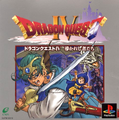
Playstation box art

Nintendo DS box art.

.png)


Miscellaneous

Symphonic Suite.

Famicom guide.

PlayStation guide.

PlayStation art.
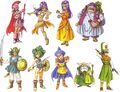
PlayStation group.

Logo of the cancelled localization of the psx remake.
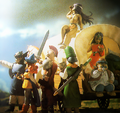
Cast.


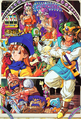


CD Theater.

CD Theater.

CD Theater.

"Legend in the Dark" novel.
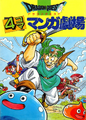
4koma comics.
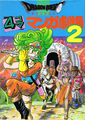
4koma comics.

4koma comics.
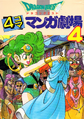
4koma comics.
4koma comics.
4koma comics.
Bosses Trading Card Game sleeve.


External links
References
- ↑ ファミ通, November 1989
- ↑ ・・・・・・今回イロイロと新しいことにチャレンジしてますけど、なかでもいちばん苦労したところはどこですか? 堀井: やっぱりAIでしょう。できあがるのに1年以上かかってますから。とにかくAIを使うっていうことは、最初からほとんど決まってたんですよね。それまでまず、'88年の2月頃から会議を初めて、延々と会議を繰り返したわけです。 最初のうちは、ほとんどAIのことばかり話しあっていたんですね。 堀井: そうです。どんな方法があるかっていうのを何回も話し合って詰めていって、6月の段階で、これだというものがやっとできあがったんです。その後プログラムに移ったわけなんですけど、実際にプログラムをする山名くんがかなり苦労をして、1年以上かかたっと思いますよ。Dragon Quest IV Master's Club page 4, ISBN4-7966-0084-1
- ↑ 堀井さんて、今までも常に反響を生かしてゲームを作っていますよね。 堀井: 反響の中でも特に、不満の部分を生かしますね。なんとかがめんどくさかったとか、それはある程度自分たちでも反省会を開いたりするんですけどね。るそういう意味では今回、コマンド体系をさらに使いやすくしたつもりです。カギを使うのがめんどくさいとか、そういった部分をすべて改善しましたから。Dragon Quest IV Master's Club page 6, ISBN4-7966-0084-1
- ↑ Dragon Quest IV Master's Club page 9, ISBN4-7966-0084-1
- ↑ 堀井: あとね、みんなが誤解してるかもしれないんで、これだけは言っておきたいんです。たとえば8人いますよね。で、ブライばかり出して戦闘してて、マーニャは馬車の中にばかりいたと。だからマーニャは、このモンスターと戦うのは初めてだという場合でも、マーニャはいちおう馬車の中から今までの戦いを見ている、という設定のもとに学習しているんです。それはナゼかって言うと、1人ずつ出して学習させるのはダルいと思ったからなんです。だから、パーティとして覚えちゃう。1人の知識はみんなの知識というような、学習機能にしちゃったんですね。結果的にはこれでよかったと思いますよ。やっぱり、それぞれのキャラクターを外に出して、何回も同じモンスターと戦うのってダルいですから。Dragon Quest IV Master's Club page 5, ISBN4-7966-0084-1
- ↑ 逆に、中にいる人は学習できないとなると、必然的に外に出すキャラって固定されますよね。 堀井: そうなんですよね。役に立つキャラばかり使うことになるから、役に立たないキャラはいつまでたっても育たないし、役に立たないままになっちゃうでしょう。それじゃ困りますからね。馬車の中のキャラも経験値がもらえるっていうのも、そのせいなんです。Dragon Quest IV Master's Club page 5, ISBN4-7966-0084-1
- ↑ "What was the inspiration for dividing Dragon Quest IV into five stand-alone chapters?" Horii: In Dragon Quest III, you went on an adventure with three companions, but these characters were simply created from scratch by the player. I thought it would be interesting to explore the lives of your comrades, which became the inspiration for Dragon Quest IV
- ↑ もう1つ目立って新しい要素として、5章構成のストーリーっていうのがあるんですけど、そもそもどうしてシナリオを5つに分けたんですか? 堀井: これもイロんな要因があるんですよ。まず、メモリーが増えるぶん、ΙIよりも長い話になりそうだと。そうすると、IIIより長い1本の話っていうのは、けっこうヘビーだと思ったわけです。長いぶん、終盤になってダレたりとかしちゃうんじゃないかとね。それだったら、スパンスパンと区切って、1本1本の話しとしてはそれほど長くないけど、全体のボリュームとしては川よるもあるという方法をとろうと思ったんです。それで何章かに分けたいというのが出てきたんですね。また、それと並行してAIを使うということになったんですよね。AIで仲間が勝手に動くと。ただ、初めから勝手に動かれたんじゃ、あまり感情移入ができないんじゃないかと思ったんです。何か変なことをやっても、プレイヤーはろくに見もせずに、ボタンを押していくだけじゃないかとね。やっぱりAIをおもしろいと感じるのは、そのAIのキャラに思い入れができないといけないわけですよね。それじゃあ、章に分けたのと合わせて、最初はAIじゃなくて、それぞれのキャラに対する思い入れをつくる部分にしようって、そう考えたわけです。コイツはこんなヤツだということがわかってこそ、5章になってからAIで動かれても、楽しめると思うんですよね。Dragon Quest IV Master's Club page 5, ISBN4-7966-0084-1
- ↑ 確かに1章なんか、イロイロな面で入門用にもピッタリという感じはしますね。 堀井: ただ、あんまりドラクエすぎてもちょっとつまらないので、ホイミンをつけてみたりとか。(笑)ちょっとだけNPC(ノンプレイヤーキャラ)の練習をさせたりもしてるんですよね。Dragon Quest IV Master's Club page 6, ISBN4-7966-0084-1
- ↑ 今のところ2章までやらせてもらったんですけど、今回は結構イベントが多そうですね。2章なんていきなりイベントがあったりして...。 堀井: そうですね。2章はバランスどりもけっこう苦労しました。というのは、町の数が多いものですから、隣の町までの距離もあまりなくて、ヘタすると1回もエンカウントせずに行けてしまう可能性があったんですよ。 それで最初の町に、注意のメッセージがあったりするわけなんですね。 堀井: あのサランの町の武器屋にはアリーナが装備できる“いばらのムチ"を売るようにしたり....。地形もモンスターに会いやすいように山を多くしたりと、いろんなことをやりました。で“いばらのムチ”を買うために戦っていると、ちょうど次の村にいっても大丈夫なレベルになっていると・・・・・・。Dragon Quest IV Master's Club page 6, ISBN4-7966-0084-1
- ↑ 週刊少年ジャンプ issue 45, page 8, 1989
- ↑ あと、カジノもやらせてもらったんですけど、あれはオトナがハマるんじゃないかと思います。
堀井: けっこう凝ってるでしょ。
・・あれは絶対ハマりますよ。**
堀井: いやあ、ボクはあそこまでチュンソフトが疑ってくれるとは思わなかったですよ。
特に格闘場が、前よりオモシロイんじゃないかなって感じがするんですが...。
堀井: 前はランダムで対戦カードを作ってたんですけど、今回は前もってある程度のカードを用意してあるんです。で、オッズ(倍率)もちゃんと設定してあるし。
オッズを調べるのが、かなり大変だったという話を聞いてますけど。
堀井: チュンソフトの浅野くんっていう人がいるんですけど、彼が、こっちのスタッフが作ったカードを何度もためしてみて、確率を計算して、オッズを作ってくれたんですよ。
- ということは逆に言えば、それだけ確かめてあるから、いくら倍率が高いとはいっても、決して勝てないというわけではないですよね。