Alefgard: Difference between revisions
No edit summary |
Antiyonder (talk | contribs) No edit summary |
||
| (57 intermediate revisions by 18 users not shown) | |||
| Line 1: | Line 1: | ||
Alefgard | [[Image:DQI_Sprite_Overworld.gif|thumb|250px|right|Alefgard, as it appears in the first {{Dragon Quest}} game released in North America, {{Dragon Warrior}}.]] | ||
[[Category:Dragon | '''Alefgard''' (アレフガルド ''Arefugarudo'') is both a land and a [[List of Kingdoms in Dragon Quest|kingdom]] featured prominently in the first three games of the {{DQSeries}}: {{DQ}}, {{DQ2}} and {{DQ3}}. | ||
[[Category:Dragon | |||
[[Category:Dragon | Alefgard is also found in {{DQSeries}}, {{DQB}}, ''[[Itadaki Street Special]]'', and ''[[Itadaki Street DS]]''. | ||
Alefgard is a series of continents connected by bridges and caves, making it easily traversable on foot. | |||
==Synopsis== | |||
[[Image:Alefgard_Guards.png|230px|right|thumb|Typical Alefgard guards]] | |||
Alefgard is the original "overworld" in the {{DQSeries}}. It is akin to [[Torland]] in {{Dragon Quest II}}. However, in later {{Main Series}} games, the concept of giving a name to the overall world map was dropped with Alefgard, [[Torland]], and [[Erdrea]] in {{Dragon Quest XI}} being the only exceptions. | |||
Although Alefgard is a set of continents divided by water, generally the divisions are quite small, requiring only bridges to connect the various land masses. The exception to this is the southeastern continent, which can be reached only via the [[Quagmire Cave]]. Rather than identifying areas by geographical location, it is easiest to identify regions by the names of towns/villages in the vicinity (i.e. the [[Kol]] region). | |||
==={{DQ}}=== | |||
Alefgard is the geographical setting of the original {{Dragon Quest}}. It contains every component of the game and must be fully explored in order to reach [[Dragonlord's Castle|Charlock Castle]] and defeat the [[Dragonlord]]. Towns featured include [[Tantegel]], [[Galenholm]], [[Kol]], [[Rimuldar]], [[Damdara]], and [[Cantlin]]. | |||
==={{DQ2}}=== | |||
Alefgard has been severely minimized in order to fit within the game due to hardware limitations, with much of the game taking place in the surrounding lands known as greater Alefgard. Almost all of the Alefgard locations have been removed with the exception of [[Tantegel]], [[Dragonlord's Castle|Charlock Castle]], and the [[Sanctum]]. Overall, Alefgard plays no significant role in {{Dragon Quest II}}. | |||
==={{DQ1&2HD}}=== | |||
{{Stub}} | |||
==={{DQ3}}=== | |||
Alefgard is the 'underworld' or 'dark world' of {{Dragon Quest III}} and is reached late in the game by leaping into the [[Great Pit of Giaga]]. This game features a full Alefgard, including some locations which did not appear in the original {{Dragon Quest}} such as the [[Tower of Rubiss]]. It also featured [[Damdara]] as a regular town, whereas the first game has it as a deserted town consisting of random monster encounters. At the end of {{Dragon Quest III}}, Alefgard is sealed off from the [[Overworld (Dragon Quest III)|overworld]]. | |||
==={{DQ3HD}}=== | |||
{{Stub}} | |||
==={{DQMCH}}=== | |||
Prince [[Kiefer]] of {{Dragon Quest VII}} adventures through a version of greater Alefgard set several centuries after the conclusion of ''Dragon Quest II''. | |||
==={{DQB}}=== | |||
The first ''Builders'' game is set in a corrupted version of Alefgard where the {{Hero 1}} accepts the [[Dragonlord]]'s offer of half the world, leading to a century of despair. The [[Builder (Dragon Quest Builders)|Builder]] is tasked by [[Rubiss]] to restore the land, bringing knowledge of construction and crafting to the people after the century of darkness has left them ignorant and vulnerable. | |||
==Culture== | |||
In modern localizations, the people of Alefgard speak Elizabethan English, while the people in the world above introduced in {{III}} speak various modern English dialects in a variety of accents. In the original localizations, people of both worlds spoke a grammatically incorrect attempt at early modern English. The {{GBC}} localizations eliminated archaicizing language entirely. | |||
As an illustration of the dialect difference, the original [[Robbin' 'Ood]] comes from the overworld and speaks a sort of Cockney English. But his descendent, introduced in the HD-2D remake of {{I}}, is a native Alefgardian, so he speaks Elizabethan English. | |||
==Music== | |||
Alefgard has its own specific world music which is used in the first 3 {{Main Series}} games. This musical theme is one of the most well known in the series. | |||
The {{NES}} versions of {{II}} and {{III}} would only use the overworld music from the first game while [[Tantegel]] for example would use the castle music of {{II}} and {{III}}. The remakes of both games would incorporate more of the first game's music into the appropriate areas | |||
==Connection to the world above== | |||
The nature of the connection between Alefgard and the world seen in ''Dragon Quest III'' is explained in the finale of {{DQ2HD}}, when [[Ramia]] escorts the [[Scions of Erdrick]] to [[Aliahan]] by flying them into a dimensional portal high in the sky. The Great Pit of Giaga houses such a dimensional portal within its depths that also connects to the open sky of Alefgard, creating the in-universe misconception that the two dimensions are physically linked in a [https://en.wikipedia.org/wiki/Hollow_Earth hollow earth] or [https://en.wikipedia.org/wiki/Celestial_spheres celestial spheres] arrangement of stratum on a cosmic scale. | |||
==See also== | |||
*[[Torland]], the invented English name for greater Alefgard used during the {{NES}} era | |||
==Gallery== | |||
<center><gallery> | |||
DQI_Sprite_Overworld.gif|Overworld Sprite Map in {{I}}. ({{NES}}). | |||
DQI_Artwork_Overworld.jpg|Overworld Artwork Map in {{I}}. | |||
DQIII_Sprite_DarkWorld.gif|{{DQ3}} Dark World Sprite Map in {{III}}. ({{NES}}). | |||
DQI 25th Anniversary Artwork Overworld.jpg|Artwork for the 25th anniversary of {{I}}. | |||
DQ Android Alefgard Map.jpg|Overworld Map in {{DQ}}. ([[Cell phone]]) | |||
DQ III Android Alefgard Map.jpg|Overworld Map in {{III}}. ([[Cell phone]]) | |||
DQB-Alefgard Map.png|Map of Alefgard for {{DQB}}. | |||
DQ Smash Grow Alefgard Citizen 1.jpg|Alefgard citizen who meets the [[party]] of another world in ''[[Dragon Quest Smash/Grow]]''. ([[Cell phone]]) | |||
DQ Smash Grow Alefgard Citizen 2.jpg|Alefgard solider needing help. ([[Cell phone]]) | |||
DQ Smash Grow First Alefgard Secret Spot 1.jpg|Secret treasure spot east of [[Quagmire Cave]]. ([[Cell phone]]) | |||
</gallery></center> | |||
{{DQI}} | |||
{{DQII}} | |||
{{DQI&IIHD}} | |||
{{DQIII}} | |||
{{DQIIIHD}} | |||
{{DQXI}} | |||
[[Category:Dragon Quest I locations]] | |||
[[Category:Dragon Quest II locations]] | |||
[[Category:Dragon Quest III locations]] | |||
[[Category:Dragon Quest III HD-2D Remake locations]] | |||
[[Category:Dragon Quest XI locations]] | |||
[[Category:Dragon Quest Builders locations]] | |||
[[Category:Overworld]] | |||
Latest revision as of 06:05, 1 May 2026

Alefgard (アレフガルド Arefugarudo) is both a land and a kingdom featured prominently in the first three games of the Dragon Quest series: Dragon Quest, Dragon Quest II: Luminaries of the Legendary Line and Dragon Quest III: The Seeds of Salvation.
Alefgard is also found in Dragon Quest series, Dragon Quest Builders, Itadaki Street Special, and Itadaki Street DS.
Alefgard is a series of continents connected by bridges and caves, making it easily traversable on foot.
Synopsis[edit]

Alefgard is the original "overworld" in the Dragon Quest series. It is akin to Torland in Dragon Quest II. However, in later Dragon Quest games, the concept of giving a name to the overall world map was dropped with Alefgard, Torland, and Erdrea in Dragon Quest XI being the only exceptions.
Although Alefgard is a set of continents divided by water, generally the divisions are quite small, requiring only bridges to connect the various land masses. The exception to this is the southeastern continent, which can be reached only via the Quagmire Cave. Rather than identifying areas by geographical location, it is easiest to identify regions by the names of towns/villages in the vicinity (i.e. the Kol region).
Dragon Quest[edit]
Alefgard is the geographical setting of the original Dragon Quest. It contains every component of the game and must be fully explored in order to reach Charlock Castle and defeat the Dragonlord. Towns featured include Tantegel, Galenholm, Kol, Rimuldar, Damdara, and Cantlin.
Dragon Quest II: Luminaries of the Legendary Line[edit]
Alefgard has been severely minimized in order to fit within the game due to hardware limitations, with much of the game taking place in the surrounding lands known as greater Alefgard. Almost all of the Alefgard locations have been removed with the exception of Tantegel, Charlock Castle, and the Sanctum. Overall, Alefgard plays no significant role in Dragon Quest II.
Dragon Quest I & II HD-2D Remake[edit]
 |
This article is a stub. You can help by expanding it. |
Dragon Quest III: The Seeds of Salvation[edit]
Alefgard is the 'underworld' or 'dark world' of Dragon Quest III and is reached late in the game by leaping into the Great Pit of Giaga. This game features a full Alefgard, including some locations which did not appear in the original Dragon Quest such as the Tower of Rubiss. It also featured Damdara as a regular town, whereas the first game has it as a deserted town consisting of random monster encounters. At the end of Dragon Quest III, Alefgard is sealed off from the overworld.
Dragon Quest III HD-2D Remake[edit]
|
|
This article is a stub. You can help by expanding it. |
Dragon Quest Monsters: Caravan Heart[edit]
Prince Kiefer of Dragon Quest VII adventures through a version of greater Alefgard set several centuries after the conclusion of Dragon Quest II.
Dragon Quest Builders[edit]
The first Builders game is set in a corrupted version of Alefgard where the Hero accepts the Dragonlord's offer of half the world, leading to a century of despair. The Builder is tasked by Rubiss to restore the land, bringing knowledge of construction and crafting to the people after the century of darkness has left them ignorant and vulnerable.
Culture[edit]
In modern localizations, the people of Alefgard speak Elizabethan English, while the people in the world above introduced in III speak various modern English dialects in a variety of accents. In the original localizations, people of both worlds spoke a grammatically incorrect attempt at early modern English. The GBC localizations eliminated archaicizing language entirely.
As an illustration of the dialect difference, the original Robbin' 'Ood comes from the overworld and speaks a sort of Cockney English. But his descendent, introduced in the HD-2D remake of DQ, is a native Alefgardian, so he speaks Elizabethan English.
Music[edit]
Alefgard has its own specific world music which is used in the first 3 Dragon Quest games. This musical theme is one of the most well known in the series.
The NES versions of II and III would only use the overworld music from the first game while Tantegel for example would use the castle music of II and III. The remakes of both games would incorporate more of the first game's music into the appropriate areas
Connection to the world above[edit]
The nature of the connection between Alefgard and the world seen in Dragon Quest III is explained in the finale of Dragon Quest II HD-2D Remake, when Ramia escorts the Scions of Erdrick to Aliahan by flying them into a dimensional portal high in the sky. The Great Pit of Giaga houses such a dimensional portal within its depths that also connects to the open sky of Alefgard, creating the in-universe misconception that the two dimensions are physically linked in a hollow earth or celestial spheres arrangement of stratum on a cosmic scale.
See also[edit]
Gallery[edit]

Overworld Artwork Map in DQ.
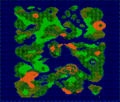
Dragon Quest III: The Seeds of Salvation Dark World Sprite Map in III. (NES).

Artwork for the 25th anniversary of DQ.

Overworld Map in Dragon Quest. (Cell phone)

Overworld Map in III. (Cell phone)

Map of Alefgard for Dragon Quest Builders.

Alefgard citizen who meets the party of another world in Dragon Quest Smash/Grow. (Cell phone)

Alefgard solider needing help. (Cell phone)

Secret treasure spot east of Quagmire Cave. (Cell phone)


